Departmental Research Themes
- Catalysis. Research within the Catalysis theme focuses on developing and understanding new catalytic processes for the manufacturing of societally important products, materials and chemicals more efficiently and with higher precision, reducing by-products and waste. In this context, our group employs theory and simulation to understand catalytic activity at a fundamental level and predict promising catalytic structures.
- Kinetics, Dynamics and Mechanism. The Kinetics, Dynamics and Mechanism theme aims at understanding chemical transformations at the quantum and molecular level. We are involved in the application of quantum chemistry methods, such as density functional theory, to elucidate the molecular mechanisms of chemical reactions, towards modelling the kinetics thereof with higher-scale methods.
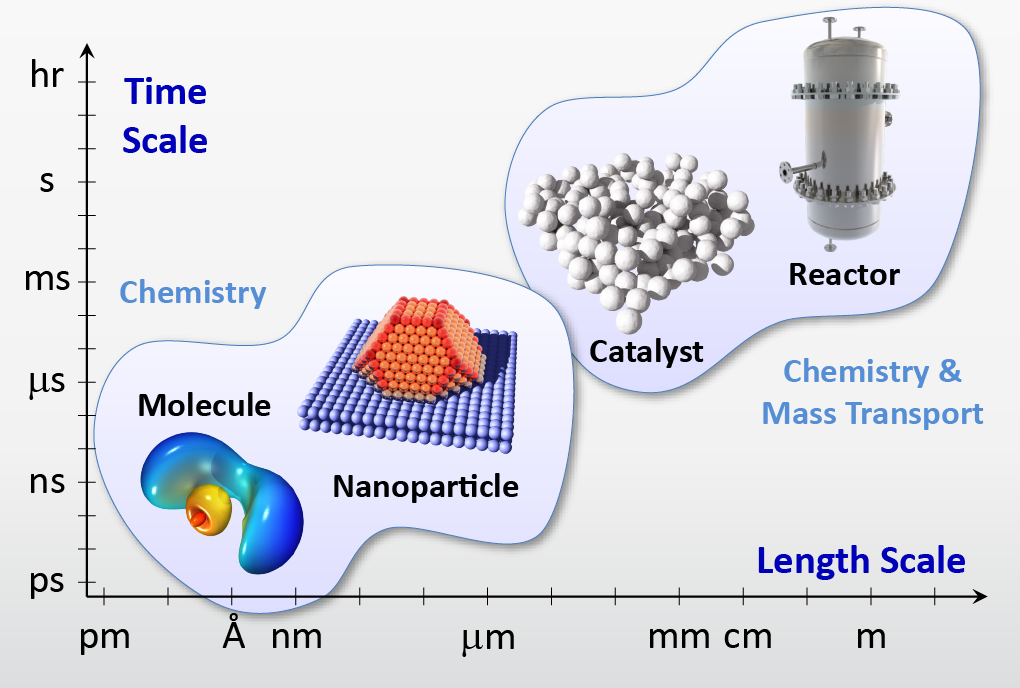
- Theory and Modelling in the Chemical Sciences. The Theory and Modelling in the Chemical Sciences theme revolves around the development of theoretical and computational modelling approaches, which play an increasingly central role in the chemistry and its many vibrant interfaces with physics, materials science and biology, wherein lie some of the most challenging problems in contemporary science. Thus motivated, our group develops kinetic Monte Carlo (KMC) approaches and software for the detailed investigation of reactions on heterogeneous catalysts, in synergy also with the Catalysis and the Kinetics, Dynamics and Mechanism research themes.
- Energy and Sustainable Chemistry. The Energy and Sustainable Chemistry theme encompasses activities that inform scientific strategies and underpin clean and green, sustainable chemical technologies that improve our environment and mitigate climate change. In this context, we are studying a variety of catalytic transformations relevant to gaseous emissions control technologies, CO2 utilisation, or biomass conversion to fuels and chemicals.
Centres and Consortia
 PREDICT: Photoelectrochemical CO2 Reduction Enhanced by Device Integration and Computational Techniques (GA: 101219185). Funded by the European Innovation Council, in the context of European Union’s Horizon Europe programme, PREDICT is a consortium of 7 partners (University of Oxford (lead), UCL, University of Iceland, National Technical University of Athens, Politecnico di Milano, Politecnico di Torino, Toyota Motor Europe) in 5 European countries. The consortium aims at developing methodological approaches and software tools for photo(electro)catalytic (PEC) materials and process modelling, and applying these tools to underpin solar-to-X innovation in collaboration with other consortia funded by the same call (HORIZON-EIC-2024-PATHFINDERCHALLENGES-01-01: Solar-to-X devices for the decentralized prosumption of renewable fuels, chemicals and materials as climate change mitigation pathway).
 CBET-EPSRC: Bespoke Porous Catalyst Design via Integrated Stochastic Modelling of Reaction and Transport in Synergy with Experiments (EP/U537019/1). Funded by the UKRI and the NSF of the USA, under a lead agency agreement scheme, the consortium involves the University of Oxford (lead), the University of Manchester and Johnson Matthey as an industrial partner (UK partners), as well as the University of Oklahoma (USA partner). It aims at developing a first-principles reactive transport kinetic Monte Carlo (KMC) approach for the simulation of porous catalytic materials by coupling the graph-theoretical KMC approach with a diffusion KMC. The approach will be benchmarked against experiments and will drive the development of such materials for key applications in sustainable chemicals manufacturing. Applications of interest encompass zeolite-catalysed reactions relevant to biomass valourisation, in particular, fructose conversion to hydroxymethylfurfural (HMF), a platform intermediate that can be converted to various other compounds that are key in the manufacturing of biofuels, polymers (plastics), pharmaceuticals, and other valuable products.